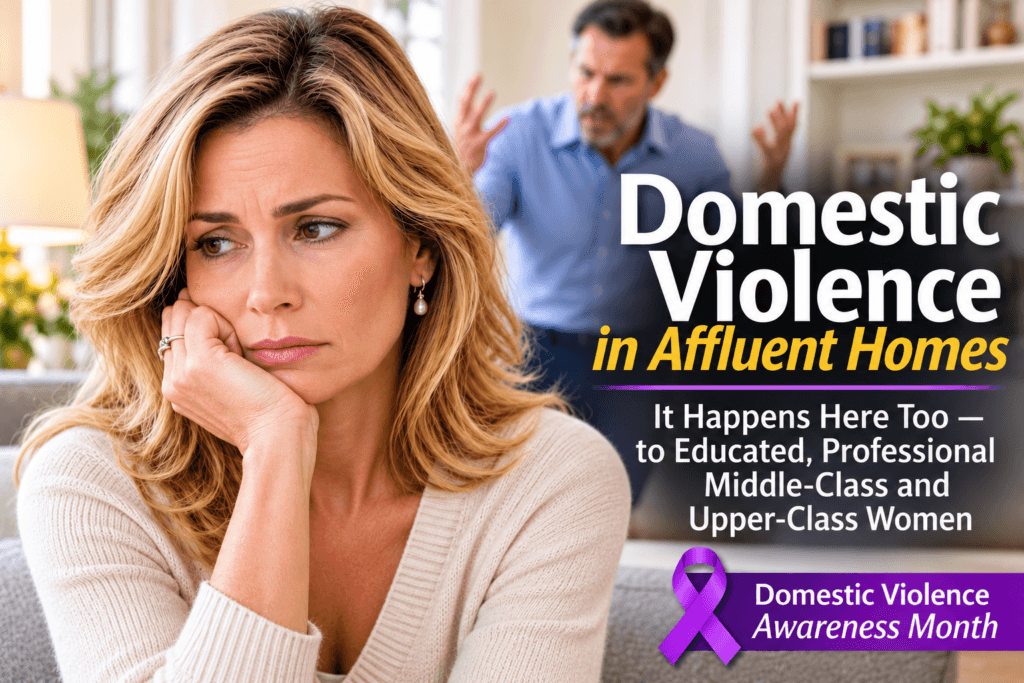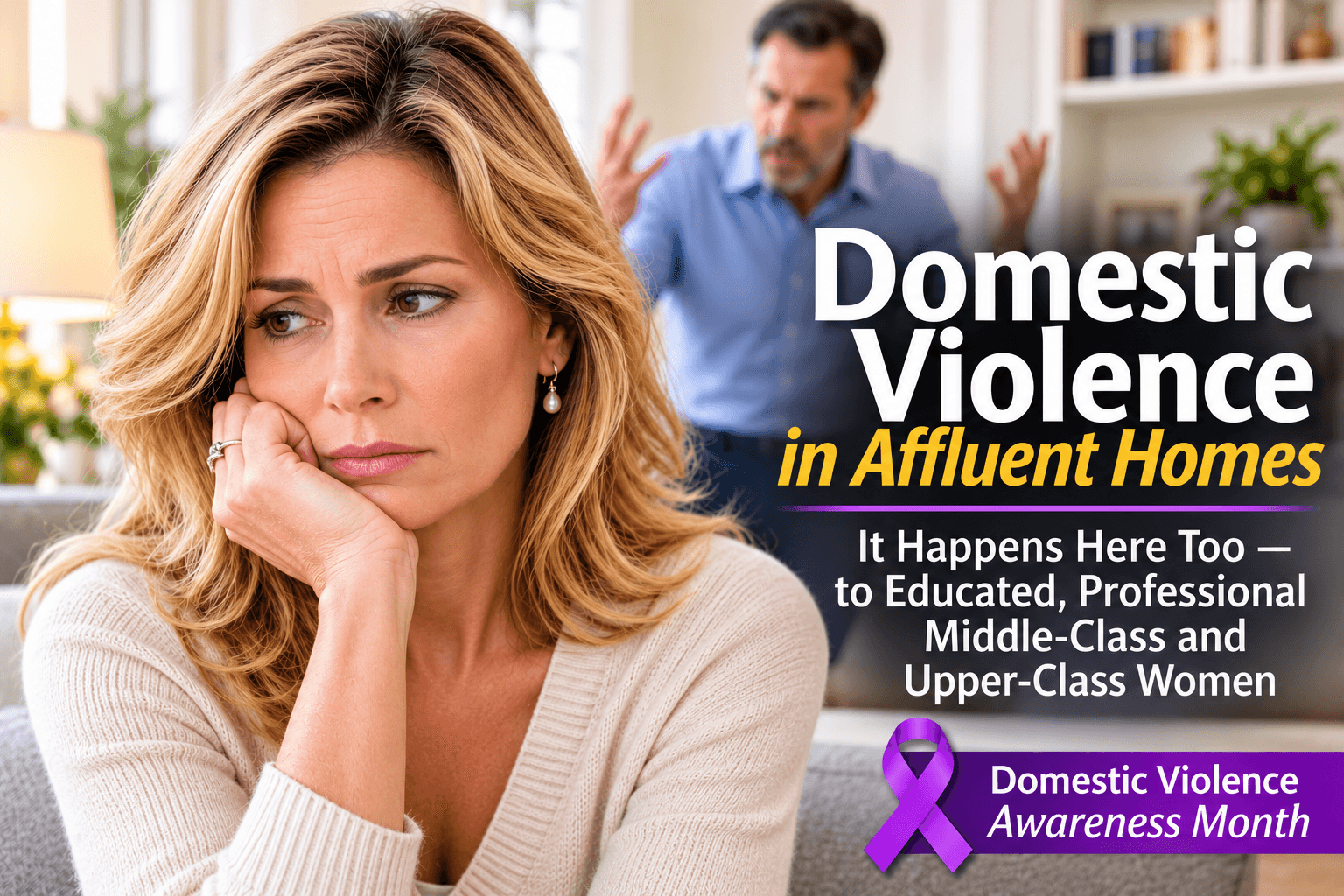
October is Domestic Violence Awareness Month.
When we think of domestic violence, we picture low-income families, shelters, and women with children seeking assistance and somewhere to escape.
That’s a limited view, and it’s the one most widely covered in the media.
Domestic violence in affluent homes is rarely discussed.
What about domestic violence in homes where educated, middle-class, upper-class and even wealthy women are subjected to violence?
Wealthy victims have lawyers, therapists and private resources. They avoid police reports and do not show up in shelters. They show up in my office.
Domestic Violence Doesn’t Only Happen to Poor Women
Domestic violence is not a poverty issue. It’s an abuser’s issue.
You can find abuse in upscale marriages, as the following real-life stories illustrate:
- A terrified client once sent me photos of her ruined bed, the product of her husband’s rage. She was lying in that bed when the husband, a reputable surgeon, broke it with his bare hands.
- I was disturbed when another client, a registered nurse, disclosed that she suffered beatings by her husband. I had known her for a while before she came forth with the truth of her abuse.
- But domestic violence is not reserved for women. More rarely, men could become victims too — like my client, a professional, whose wife would throw knives at him when she was enraged and under the influence of alcohol.
Why Domestic Violence in Wealthy Families Remains Hidden
Why do educated, professional or wealthy victims hide the truth of domestic violence they are subjected to? There may be several reasons:
- Disappointing Others — when a couple is prominent in a community, they are looked up to by family, friends, colleagues, and other members of the community. A shakeup in their family deeply disappoints the people around them. That’s an outcome any decent person wishes to avoid.
- Social Status — is a significant component of upper-class living, and “looking good” to others is a part of it. Life in the wealthier sector entails a certain façade. Revealing any ugliness behind those curtains is avoided.
- Effect on Children — the effect marital shakeups have on children is always heartbreaking. But in wealthy families there is also fear that the children’s access to social circles, future opportunities, and higher-class privileges would be affected. Victims of domestic violence may sacrifice their own well-being for their children.
- Lifestyle Change or Reduction — while educated, professional or wealthy women are not likely to find themselves on the street or in shelters, their budget might be cut and their financial resources might be affected resulting in a forced change in lifestyle.
- Damaged Career or Reputation — disclosing domestic violence in upscale marriages could harm the spouse’s or the victim’s career or reputation resulting in economic damage.
- Shame — no one, of any class, is proud to admit being a victim of domestic violence. It can be humiliating and embarrassing. And it raises the question of “why are you still with him/her?” which the victim may not be ready to answer.
- Fear — fear of retaliation. After all, the victim is already dealing with an abusive partner. How much more violent might the partner become if the truth of their domestic violence is revealed?
Who’ll believe me? My husband is successful.
The victim might be trapped in the predicament of “who’ll believe me, my husband is successful,” or “my husband is respected in the community but abusive at home.” She may also be wondering how to leave an abusive spouse without losing everything.
This can be so overwhelming that victims put off decisions for months and years, while the abuse continues.
Early Signs of Domestic Violence
Full-scale domestic violence doesn’t happen overnight. It is usually preceded by milder incidents and behaviors that signal trouble. If left untreated, this could build up. If detected and addressed early on, domestic violence could be prevented.
What are some of those signs?
- Verbal abuse — often happens before physical violence: partner gets rude and loud, disrespectful, belittling, humiliating, uncaring or dismissive.
- Emotional and financial abuse in marriage or relationship — those go along with verbal abuse. Financial restraint is a form of control by abusers who seeks to keep victims dependent on them.
- Alcohol and drugs — both illicit and prescription — could result in aggressive behavior. Studies show that even marijuana, which is legal in some states, has been linked to psychosis — a condition whereby the user is disconnected from reality.Long before aggression takes place, the future victim must recognize the role mind-altering substances play in changing behavior and the liability that they are to the relationship.Don’t downplay substance use. It must be addressed and eliminated, or you will suffer the consequences.
- Change in behavior — the once-loving partner takes you for granted and has increasingly worsening behavior. I cover that in my article Your Partner Changed After Getting Comfortable—Facing the Truth, which you can find on our blog.
- Communication issues — precede violence. When a couple can’t communicate but only argue, there is a disconnect. They don’t understand each other. They might get into what I call in my book a “power struggle” whereby proving that one is right and the partner is wrong becomes more important than living happily.Work on your communication and learn to resolve conflict without arguing. Read my book — Stop Fighting and Start Communicating — or contact us for marriage or relationship coaching.
If early warning signs are allowed to continue, they could escalate and result in violent episodes. And episodes, with time, become routines.
How to Leave an Abusive Spouse Without Losing Everything
Victims of domestic violence — in both poor and wealthy homes — must, at some point, make their own decisions about their lives and survival.
Every human being has certain basic right. They are called human rights.
There are thirty human rights which are described in The Universal Declaration of Human Rights, adopted by the United Nations in December 1948. (Visit https://www.youthforhumanrights.org)
Among them are (number 3) the right to life, liberty and security and (number 5) the right to not suffer torture, cruel, inhuman or degrading treatment.
Victims of domestic violence must realize that living a life free of violence is their basic human right.
If abuse continues, they should seek advice from a family law attorney, financial advisor or family members, and plan their safe exit.
Help Is Available
If you find yourself at any stage of abuse, whether you’re seeing early signs or are at the end of your rope, reach out to me. I may be able to help.
And I’ll let you know whether or not I can. We only accept clients I feel we can help.
I wish you and yours a safe, peaceful and blessed home life.
Daphna